
How to Report a Romance Scammer
Discovered you've been scammed? This complete guide shows you exactly how to report a romance scammer to the FBI, FTC, police, banks, and dating platforms—plus realistic expectations about recovery and what happens after you report.
10/14/202519 min read

Quick Answer: To report a romance scammer, file reports with the FBI's Internet Crime Complaint Center (IC3.gov), the Federal Trade Commission (FTC), the dating platform where you met them, your local police (if money was involved), and your bank or payment service immediately. Reporting helps law enforcement track scammers, protects other potential victims, and creates documentation if you need to dispute financial losses.
You've discovered you were scammed. The person you trusted, the relationship you believed in—it was all a lie. Now you're facing a choice: do you report what happened, or do you try to move on quietly?
This moment feels heavy. Reporting means acknowledging what happened. It means facing the embarrassment, the shame, the frustration of having been deceived. It might feel easier to just walk away and pretend it never happened.
But here's what you need to know: reporting a romance scammer isn't just about you. It's about protecting the next person. And it's about giving yourself the best possible chance of recovery—financially, emotionally, and legally.
This guide will walk you through exactly how to report a romance scammer, step by step, across every platform that matters. You'll learn where to report, what information to gather, what to expect after reporting, and how to maximize your chances of getting justice or financial recovery.
You didn't ask to be in this position. But now that you're here, taking action is one of the most empowering things you can do.
Why Reporting Romance Scammers Actually Matters
Before we get into the how, let's address the why. Many people skip reporting because they think it won't make a difference. Here's why it absolutely does.
Reason #1: You Help Law Enforcement Track Patterns
Romance scammers rarely work alone. Many are part of organized crime networks operating across multiple countries. When you report a romance scammer to the FBI or FTC, your report becomes part of a larger database that helps law enforcement:
Identify scam networks operating across multiple victims
Track money flows and identify how funds are being moved
Build cases against organized fraud operations
Recognize patterns in how scammers operate
Allocate resources to shut down major operations
Your single report might seem small, but when combined with hundreds or thousands of others, it creates a clear picture that helps authorities take action.
Reason #2: You Protect Future Victims
Every time you report a romance scammer, you're creating a trail that can help protect others:
Dating platforms can remove fake profiles faster
Banks can flag suspicious accounts
Payment services can identify fraudulent transactions
Other potential victims might search the scammer's information and find your report
Awareness increases about specific tactics being used
The person who scammed you is almost certainly targeting other people right now. Your report could be what saves someone else from the same pain.
Reason #3: You Create Legal Documentation
If you sent money, reporting creates an official record that can help you:
Dispute transactions with your bank or credit card
File insurance claims if applicable
Document losses for tax purposes (in some cases, fraud losses may be deductible)
Pursue legal action if the scammer is ever identified and prosecuted
Protect your credit if identity theft becomes an issue
Without an official report, recovering money or proving what happened becomes significantly harder.
Reason #4: You Take Back Your Power
Being scammed makes you feel powerless. Someone took advantage of your trust and exploited your vulnerability. Reporting is one way to reclaim agency in the situation.
Reporting says:
"I'm not going to stay silent"
"I'm going to do what I can to stop this person"
"I refuse to let shame keep me from protecting others"
"I'm taking action, not just accepting this"
This psychological shift—from victim to advocate—is actually part of healing. Many people report feeling more empowered after filing reports, even if they never see direct results.
Before You Report: Information to Gather
The more documentation you have, the more effective your reports will be. Before you start filing, gather the following information. Don't worry if you don't have everything—report anyway. But collect what you can.
Essential Information to Collect
About the scammer:
✓ Full name they used (and any variations)
✓ Dating profile username and URL
✓ Phone numbers they used
✓ Email addresses they used
✓ Social media profiles (even if fake)
✓ Photos they sent you
✓ Physical addresses they claimed (even if fake)
✓ Details about their claimed identity (job, location, military service, etc.)
About the financial transactions:
✓ Dates money was sent
✓ Amounts sent
✓ Method used (wire transfer, gift cards, cryptocurrency, check, etc.)
✓ Account numbers or wallet addresses where money was sent
✓ Names on receiving accounts
✓ Payment service used (Western Union, MoneyGram, PayPal, Venmo, etc.)
✓ Receipts or confirmation numbers
Communication records:
✓ Screenshots of conversations (dating app, text, email)
✓ Screenshots showing requests for money
✓ Voice recordings if you have them (check local laws first)
✓ Timeline of the relationship (when you met, major events)
✓ Any promises they made about meeting or the future
How to Organize Your Documentation
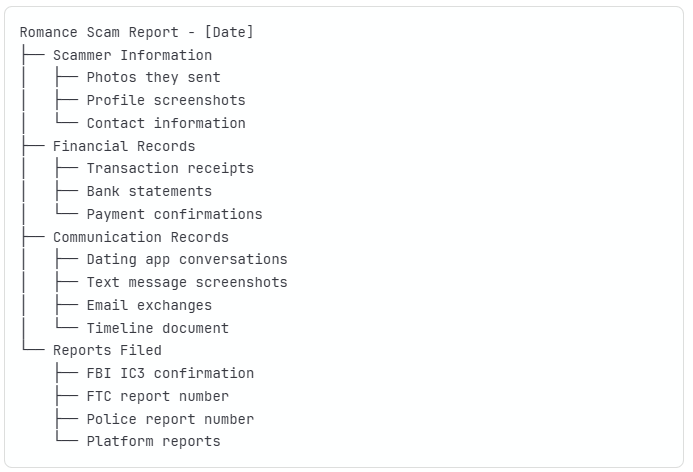
Create a folder (digital or physical) with everything organized:
Folder structure:
Pro tip: Take screenshots of everything before the scammer deletes their profile or blocks you. Once they're gone, you lose access to that evidence.
Step-by-Step: Where and How to Report Romance Scammers
Now let's get into the actual reporting process. You should file reports in multiple places—each serves a different purpose and increases the chances of action being taken.
Report #1: FBI Internet Crime Complaint Center (IC3) — MOST IMPORTANT
Why this matters: The FBI's IC3 is the primary federal agency tracking online fraud, including romance scams. Your report goes into a national database used to identify patterns and build cases.
Who should report here: Everyone who was scammed online, especially if money was involved.
Step-by-step process:
Go to IC3.gov
Click "File a Complaint"
Create an account or file as a guest (account recommended for tracking)
Fill out the complaint form with:
Your personal information (name, address, contact)
Scammer's information (everything you gathered)
Detailed description of what happened
Financial loss information
Supporting documentation (upload screenshots, receipts)
Submit the report
Save your complaint number for your records
What to include in your description:
Be detailed and chronological. Example:
"I met [Name] on [Dating Platform] on [Date]. They claimed to be [claimed identity]. Over [timeframe], we developed a relationship through [communication methods]. On [date], they requested money for [reason given]. I sent $[amount] via [method]. They continued requesting money on [dates] for [reasons], totaling $[total amount]. I discovered the scam when [how you found out]. I have attached screenshots of conversations and financial transactions."
What happens after you report:
You'll receive a complaint number immediately
The FBI reviews all reports but won't contact you unless they need more information
If your case is part of a larger investigation, they may reach out
You likely won't hear back unless there's significant action (this is normal)
Timeline: Report filed immediately; FBI review happens within days to weeks; investigation (if any) can take months to years.
Report #2: Federal Trade Commission (FTC) — CONSUMER PROTECTION
Why this matters: The FTC tracks consumer fraud and provides data to help prevent future scams. They also coordinate with other agencies and can take action against scam operations.
Who should report here: Everyone who experienced romance fraud, even if no money was lost.
Step-by-step process:
Go to ReportFraud.FTC.gov
Select "Romance Scam" or "Online Shopping and Negative Reviews" (if romance scam isn't listed)
Answer the questions about what happened:
How you met the scammer
What they promised or claimed
What you lost (money, personal information)
How you paid (if applicable)
Provide scammer details (name, contact information, dating profile)
Upload supporting documents if available
Submit your report
Print or save your reference number
What to emphasize:
The method of contact (dating app, social media)
The tactics used (love bombing, urgency, crisis stories)
The payment method requested (wire transfer, gift cards, cryptocurrency)
Whether your personal information was compromised
What happens after you report:
Your report is added to the FTC's Consumer Sentinel Network
Data is shared with law enforcement agencies
You receive a reference number for your records
The FTC may contact you if they need clarification
You'll get information about next steps and resources
Timeline: Report filed immediately; added to database within 24 hours; no direct follow-up expected unless part of a major case.
Report #3: The Dating Platform or Social Media Site — REMOVE THE PROFILE
Why this matters: Dating platforms and social media sites can remove the scammer's profile, preventing them from targeting more people on that platform.
Who should report here: Everyone who met the scammer on a dating app, social media platform, or website.
How to report on major platforms:
Dating Apps:
Tinder:
Open the scammer's profile or conversation
Tap the shield icon or three dots
Select "Report [Name]"
Choose "Scam" or "Suspicious Behavior"
Provide details
Submit
Bumble:
Go to the conversation or profile
Tap the three dots
Select "Block & Report"
Choose "Scam" as the reason
Add details and submit
Go to their profile
Click "Report this member"
Select "Suspected scammer"
Provide details
Submit report
Hinge:
Open the conversation
Tap the three dots
Select "Report"
Choose "Scam or fraud"
Provide details
eHarmony:
Go to their profile
Click "Report this member"
Select reason (fraud/scam)
Submit with details
Social Media:
Facebook:
Go to the profile
Click the three dots
Select "Find support or report profile"
Choose "Scam or fraud"
Follow prompts to submit
Instagram:
Go to the profile
Tap the three dots
Select "Report"
Choose "It's a scam"
Provide details
What to include in platform reports:
Screenshots of requests for money
Evidence of fake identity (if you have it)
Description of the scam tactics used
Any evidence of multiple fake profiles
What happens after you report:
Platform reviews within 24-48 hours
Profile may be removed or suspended
You'll receive confirmation of action taken (or not)
The scammer may create new profiles (report those too)
Important: Platforms don't share user information with you for privacy reasons, so you won't learn the scammer's real identity through this process.
Report #4: Local Police Department — CREATE LEGAL DOCUMENTATION
Why this matters: A police report creates official legal documentation of the crime. This is especially important if you sent money or if your identity was compromised.
Who should report here: Anyone who lost money, had identity information stolen, or wants official legal documentation.
Step-by-step process:
Contact your local police department's non-emergency number
Ask to file a report for online fraud or romance scam
Bring your documentation (printed or on your phone):
Scammer information
Financial records
Communication screenshots
Timeline of events
File the report in person or online (some departments allow online reporting)
Get a copy of the police report with case number
Ask how to follow up if you have additional information
What to tell the police:
Be clear and factual:
"I was the victim of an online romance scam"
"I met someone on [platform] who claimed to be [identity]"
"I sent $[amount] on [dates] via [method]"
"I discovered it was a scam when [what happened]"
"I'm filing this report for documentation purposes and to help with potential recovery efforts"
What happens after you report:
You receive a case number and report
The detective may or may not follow up (depends on jurisdiction and amount)
You can use the report for bank disputes and insurance claims
The report becomes part of public record
If the scammer is ever caught, your report can be evidence
Important reality check: Local police often have limited resources for investigating online fraud, especially when scammers are overseas. Many won't actively investigate unless the amount is very large or part of a bigger pattern. This doesn't mean reporting isn't valuable—the documentation itself is crucial for other steps.
Report #5: Your Bank or Payment Service — TRY TO RECOVER MONEY
Why this matters: If you sent money, immediate reporting to your bank or payment service gives you the best chance of recovering funds or disputing transactions.
Who should report here: Anyone who sent money via bank transfer, credit card, debit card, or payment apps.
How to report by payment method:
Bank Wire Transfer:
Call your bank immediately (the sooner, the better)
Report the transaction as fraudulent
Request a wire recall (only works if money hasn't been withdrawn yet)
File a fraud claim with your bank
Provide documentation: police report, scammer info, evidence it was fraud
Follow up in writing via email or letter
Timeline: Wire recalls must be initiated within 24 hours for best chance of success. After money is withdrawn, recovery is nearly impossible.
Credit Card:
Call your credit card company's fraud department
Dispute the charges as fraudulent
Explain the situation: you were deceived into making payments
Provide evidence: screenshots, police report, scammer information
Follow dispute process (usually 30-60 days for investigation)
Timeline: Credit card disputes have better success rates. Companies can reverse charges if you report quickly.
Payment Apps (Venmo, PayPal, Cash App, Zelle):
PayPal:
Go to Resolution Center
Report a Problem
Select the transaction
Choose "I was scammed"
Provide evidence
Submit claim
Venmo:
Contact Venmo support
Report the transaction as unauthorized or fraudulent
Provide details
Note: Venmo offers limited protection for fraud
Cash App:
Go to transaction history
Select the payment
Report as fraud
Contact support
Note: Very limited fraud protection
Zelle:
Contact your bank (Zelle operates through banks)
Report fraud
Note: Zelle offers almost no fraud protection for authorized payments
Gift Cards (iTunes, Google Play, Amazon, etc.):
Contact the gift card company immediately
Report the card numbers as used in a scam
Provide proof of purchase and fraud
Request reversal or freeze (rarely successful, but worth trying)
Report to the FTC (gift card scams are tracked separately)
Reality check: Gift card scammers specifically use this method because it's nearly impossible to recover. Gift card companies rarely refund once codes are redeemed.
Cryptocurrency:
Report to the cryptocurrency exchange you used
Provide transaction details (wallet address, amount, date)
File complaints with FTC and IC3
Contact a cryptocurrency recovery service (if amount is large enough)
Reality check: Cryptocurrency transactions are designed to be irreversible. Recovery is extremely rare unless the funds haven't been moved yet.
What increases your chances of recovery:
✓ Report within 24-48 hours ✓ Have documentation ready ✓ File police report first ✓ Be persistent with follow-ups ✓ Escalate to supervisors if initial claims are denied ✓ Reference consumer protection laws
Report #6: State Attorney General's Office — CONSUMER PROTECTION
Why this matters: State attorneys general handle consumer fraud and can take action against scam operations, especially those operating within your state.
Who should report here: Anyone who experienced significant financial loss or wants additional consumer protection support.
How to report:
Find your state's Attorney General website (search "[Your State] Attorney General consumer complaint")
Locate the consumer protection division
File an online complaint (most states have online forms)
Provide all documentation:
Scammer information
Financial losses
Communication records
Other reports filed (FBI, FTC, police)
Submit and save confirmation
What happens after you report:
Your complaint is reviewed by consumer protection staff
If part of a pattern, they may investigate
Some AG offices provide mediation services
You receive a case number for tracking
Updates provided if action is taken
Report #7: Internet Crime Reporting Sites — COMMUNITY WARNING
Why this matters: These sites allow victims to share stories and warn others. While not official law enforcement, they help potential victims find information about specific scammers.
Where to report:
Community forum where victims share stories
Search scammer names and photos
Post your experience to warn others
Database of reported scammers
Upload scammer photos and information
Search to see if others reported the same person
Focused on advance-fee fraud (common in romance scams)
Community of scam-baiters and victim support
Educational resources
Reverse image search for dating profiles
Report fake profiles
Verify identities
How to use these effectively:
Search the scammer's information before reporting (see if others were targeted)
Upload photos for reverse image search
Share your story to warn others
Be factual, not emotional (keeps information credible)
Don't include personal identifying information about yourself
Special Circumstances: Additional Reporting Scenarios
If You're a Victim of Military Romance Scam
In addition to all the standard reports, also report to:
U.S. Army Criminal Investigation Command
Website: www.cid.army.mil
Report fake military profiles
Provides verification of real military members
Investigates military impersonation
Military branch-specific fraud hotlines:
Each branch has fraud reporting
They track impersonation of service members
Can take action against fake military profiles
If Your Identity Was Stolen or Compromised
If the scammer has your Social Security number, passport information, or other sensitive data:
File an identity theft report with IdentityTheft.gov
Place a fraud alert on your credit reports (contact one bureau, they notify others)
Consider a credit freeze (prevents new accounts from being opened)
Monitor your credit reports closely for 12+ months
Report to local police specifically as identity theft
Keep documentation of all steps taken
If You're International
If you're outside the U.S.:
Interpol: Some countries allow reporting through Interpol for international fraud
Local law enforcement: File in your home country
National consumer protection agencies: Most countries have equivalent to FTC
Dating platform: Still report on the platform regardless of location
IC3: The FBI IC3 accepts reports from international victims if U.S. entities are involved
If You're Underage
If you're under 18 and were targeted by a romance scammer:
Tell a trusted adult immediately (parent, guardian, school counselor)
Report to National Center for Missing & Exploited Children (if sexual content was involved): CyberTipline.org
Report to local police (minors receive additional protections)
Report to the platform where you were contacted
Save all evidence but don't engage further
What Happens After You Report: Setting Realistic Expectations
One of the hardest parts of reporting a romance scammer is understanding what to expect afterward. Let's be honest about the likely outcomes.
What Will Probably Happen
Reality #1: You likely won't hear back from law enforcement
The FBI, FTC, and police receive thousands of romance scam reports. Unless your case is part of a larger investigation or involves an unusually large amount of money, you probably won't receive individual follow-up. This doesn't mean your report wasn't valuable—it was added to databases that help identify patterns.
Reality #2: You probably won't get your money back
Romance scammers often operate from overseas, move money quickly through multiple accounts, and use methods designed to be irreversible (gift cards, cryptocurrency, wire transfers). Recovery rates are very low, typically under 5%. However, reporting quickly improves your odds, especially with credit card disputes.
Reality #3: The scammer probably won't be caught
Most romance scammers operate from countries with limited law enforcement cooperation. They use fake identities, burner phones, and VPNs. Individual scammers are rarely prosecuted. However, when larger networks are identified through multiple reports, coordinated takedowns do happen.
Reality #4: The platform will remove the profile (eventually)
Dating platforms do take down reported profiles, but it often takes 24-48 hours. Meanwhile, the scammer may have already moved to other platforms or created new profiles. Continue reporting any new profiles you discover.
What Might Happen (Less Common, But Possible)
Possibility #1: You might be contacted by investigators
If your scammer is part of a larger operation being investigated, law enforcement may reach out for additional information or testimony. Cooperate fully if this happens—your contribution could help shut down a scam network.
Possibility #2: You might recover funds through your bank
Credit card chargebacks and bank fraud disputes have higher success rates than other methods. If you reported quickly and provided strong evidence, you might get partial or full reimbursement.
Possibility #3: Your report might prevent others from being scammed
When dating platforms remove profiles quickly, when banks flag suspicious accounts, when law enforcement identifies patterns—your report contributes to all of this. You may never know whose life you changed by reporting.
The Value of Reporting Even Without Immediate Results
Even if nothing dramatic happens after you report, you've accomplished something important:
✓ You took action instead of staying silent
✓ You created documentation that protects you legally and financially
✓ You contributed to data that helps law enforcement
✓ You potentially protected future victims
✓ You reclaimed agency in a situation where you felt powerless
How Long Does the Reporting Process Take?
Here's a realistic timeline:
Immediate (Day 1):
IC3 report: 20-30 minutes
FTC report: 15-20 minutes
Platform reports: 5-10 minutes each
Bank/payment service calls: 30-60 minutes
Within 24-48 Hours:
Police report: 1-2 hours (includes travel time)
State AG report: 15-20 minutes
Within a Week:
Follow-up with bank fraud claims
File additional reports if you discover more information
Organize documentation for potential disputes
Total time investment: 3-5 hours spread over a few days
Worth noting: You don't have to do everything in one day. Start with IC3 and your bank (those are time-sensitive), then complete others as you have time.
Common Mistakes to Avoid When Reporting
Mistake #1: Waiting Too Long to Report
Why it's a problem: The sooner you report, especially to banks, the better your chances of recovery. Scammers move money quickly.
What to do instead: Report to your bank within 24 hours if money was involved. File other reports within a week.
Mistake #2: Not Providing Enough Documentation
Why it's a problem: Vague reports are harder for authorities to act on. Detailed reports with evidence are more valuable.
What to do instead: Gather screenshots, receipts, and timelines before you start reporting. Include as much detail as possible.
Mistake #3: Only Reporting to One Place
Why it's a problem: Different agencies serve different purposes. Filing only with the FBI but not your bank means you miss recovery opportunities. Filing only with the platform but not law enforcement means no legal documentation.
What to do instead: Report to all relevant agencies and institutions. Each serves a different purpose in protecting you and others.
Mistake #4: Expecting Immediate Results
Why it's a problem: Setting unrealistic expectations leads to frustration and feeling like reporting was pointless.
What to do instead: Understand that reporting is about documentation, pattern recognition, and future protection—not necessarily immediate justice or recovery.
Mistake #5: Continuing to Communicate With the Scammer
Why it's a problem: Some victims continue talking to the scammer while reporting, hoping to get more information or closure. This can compromise investigations and keep you emotionally attached.
What to do instead: Block the scammer immediately after gathering your documentation. No more contact.
Mistake #6: Not Following Up
Why it's a problem: Banks and payment services often require multiple follow-ups on fraud claims. One call isn't enough.
What to do instead: Mark your calendar to follow up weekly on pending claims. Keep detailed notes of who you spoke with and what was said.
Protecting Yourself Going Forward
After reporting, take these additional steps to protect yourself:
Immediate Protection Steps
Change your passwords — Especially if the scammer had any access to your accounts
Enable two-factor authentication — On all important accounts (email, banking, social media)
Monitor your credit — Sign up for free credit monitoring (Credit Karma, AnnualCreditReport.com)
Check for new accounts — Review credit reports for accounts you didn't open
Update security questions — If the scammer knows personal information about you
Review privacy settings — On social media and dating profiles
Long-Term Protection
Be more cautious online — Use verification techniques before trusting someone new
Trust your instincts — If something feels off, investigate before investing emotionally
Slow down emotional connections — Real relationships don't require urgent trust
Never send money to someone you haven't met — No exceptions, no matter how good the reason sounds
Video chat early and often — Real people can and will video chat
Tell friends about new relationships — External perspective helps catch red flags
When Reporting Feels Too Hard: It's Okay to Get Help
If you're struggling with the reporting process, know that you don't have to do it alone.
Resources that can help:
AARP Fraud Watch Network (for all ages, despite the name)
Helpline: 1-877-908-3360
Free support for fraud victims
Can help guide you through reporting
National Elder Fraud Hotline (if you're over 60)
Phone: 1-833-FRAUD-11 (1-833-372-8311)
Case managers who help with reporting
Local victim advocate services
Many police departments have victim advocates
They can help with paperwork and reporting
Free service
Friends or family
Ask someone you trust to sit with you during calls
They can help organize documentation
Support matters during this process
If You're Overwhelmed
It's okay to:
Take breaks between filing reports
Ask for help from someone you trust
Focus on the most important reports first (IC3, bank, police)
Come back to other reports when you have energy
You're not required to do everything perfectly. Even partial reporting is better than no reporting.
Your Reporting Checklist: What to Do This Week
Use this checklist to track your reporting progress:
Priority 1 (Do Today If Money Was Involved):
Contact your bank/credit card company
Request wire recall or dispute charges
File fraud claim with payment service
Document all conversations
Priority 2 (Do This Week):
File IC3 report at IC3.gov
File FTC report at ReportFraud.FTC.gov
Report to dating platform where you met
File police report (in person or online)
Save all confirmation numbers
Priority 3 (Do Within Two Weeks):
File state Attorney General report
Report to community sites (RomanceScams.org, etc.)
If military scam: Report to CID
If identity theft: File at IdentityTheft.gov
Follow up on bank fraud claims
Ongoing:
Monitor credit reports monthly
Follow up on fraud claims weekly
Document any new contact from scammer
Keep all documentation organized
Moving Beyond Reporting: What Comes Next
Reporting is a crucial step, but it's just one part of your recovery. After you've filed your reports, you'll need support for the emotional healing, rebuilding trust, and moving forward.
The Bigger Picture
You've done something important by reporting. You've:
Taken back control
Protected others
Created legal documentation
Stood up against fraud
Now it's time to focus on your own recovery and protection going forward.
Common Questions After Reporting
"How long until I hear back?" Most agencies won't provide individual updates unless they need more information. This is normal and doesn't mean your report wasn't valuable.
"Will I get my money back?" Unfortunately, recovery rates are low. Focus on the fraud claim with your bank as your best option, but prepare emotionally for the possibility that the money is gone.
"What if the scammer contacts me again?" Don't respond. Block immediately. Report the new contact to all the agencies where you filed reports.
"Should I warn the scammer's other victims?" Be careful here. If you find their profiles on dating sites, report them to the platform. Don't confront the scammer or try to become a vigilante—it can be dangerous and compromise investigations.
"How do I prevent this from happening again?" Education, verification, and trusting your instincts. You're already doing this by reading articles like this one.
You've Taken an Important Step
If you've read this far, you're someone who takes action. You're not letting what happened define you. You're doing what you can to protect yourself and others.
Reporting a romance scammer is not easy. It requires:
Facing what happened
Organizing documentation
Spending time on phone calls and forms
Overcoming shame or embarrassment
Persisting even when results aren't immediate
But you're doing it anyway. That takes courage.
Remember:
This wasn't your fault
Reporting helps more people than just you
Your actions matter even if you don't see immediate results
You're stronger than you think
Get Complete Support for What Comes Next
Reporting is just the beginning. You've protected yourself legally and helped protect others, but now you need a comprehensive plan for recovery, rebuilding, and moving forward with confidence.
Beyond Reporting: Your Complete Roadmap
If you're looking for comprehensive guidance that covers not just reporting, but every aspect of navigating life after a romance scam, The Romance Scam Survival Guide gives you everything you need in one place.
This complete guide includes:
✓ Detailed reporting templates — Pre-written scripts and forms to make reporting easier
✓ Financial recovery strategies — Maximize your chances of getting money back
✓ Emotional healing roadmap — Process the betrayal and rebuild trust in yourself
✓ Protection protocols — Never fall for manipulation again
✓ Red flag identification — Recognize scammers before you invest emotionally
✓ Recovery timeline — Know what to expect and when
✓ Self-compassion exercises — Stop blaming yourself and start healing
✓ Moving forward strategies — When and how to trust again
The Romance Scam Survival Guide takes you from crisis to recovery to thriving again—with practical, compassionate guidance every step of the way.
You've already taken the hardest step by recognizing what happened and taking action to report it. Now give yourself the complete support system you deserve.
Get your copy here: https://scamprooflove.com/the-romance-scam-survival-guide
This isn't just another generic fraud guide. It's specifically designed for people who've experienced romance scams and catfishing—people who are dealing with both financial and emotional betrayal. People like you who deserve real answers and real support.
Final Thoughts: You're Not Alone
Thousands of people report romance scams every year. You're part of a community of people who trusted, who were deceived, and who are now taking action.
What you need to know right now:
You were targeted by professionals — These scammers know exactly what they're doing
Your capacity for trust is a strength — It was exploited, not a weakness
Reporting helps more than you know — Even if you never see direct results
You will heal from this — With time, support, and the right resources
You can trust again — More wisely, with verification, but you can
The fact that you're here, reading this guide, taking the steps to report and protect yourself—that shows resilience. That shows strength. That shows you're not going to let this define you.
You've got this. And you don't have to do it alone.
Quick Reference: Essential Reporting Links
Save these for easy access:
Federal Agencies:
FBI IC3: https://www.ic3.gov
FTC Report Fraud: https://reportfraud.ftc.gov
Identity Theft: https://www.identitytheft.gov
Financial:
Contact your bank's fraud department directly
PayPal Resolution Center: paypal.com/resolutioncenter
Credit bureau fraud alerts: Equifax.com, Experian.com, TransUnion.com
Dating Platforms:
Report directly through the app/website where you met the scammer
Each platform has a "Report" button on profiles
Community Resources:
Romance Scams: https://www.romancescams.org
Scam Digger: https://www.scamdigger.com
Social Catfish: https://socialcatfish.com
Support:
AARP Fraud Watch: 1-877-908-3360
National Elder Fraud Hotline: 1-833-372-8311
One More Thing: Update Your Progress
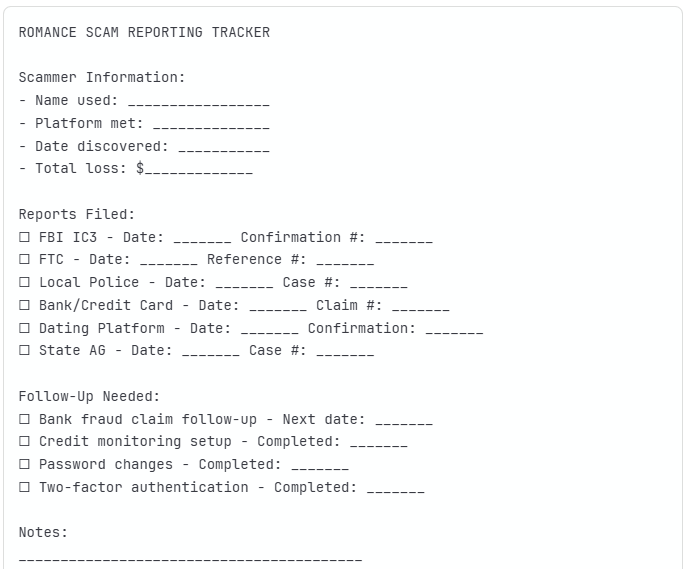
As you work through reporting, keep track of what you've completed. Create a simple tracking document:
This tracker helps you stay organized and ensures nothing falls through the cracks.
You've Done Something Powerful Today
By reading this guide and taking steps to report, you've:
✓ Refused to stay silent
✓ Taken action to protect others
✓ Created legal documentation for your protection
✓ Reclaimed agency in your situation
✓ Started the path toward healing
That's not small. That's significant.
The road ahead might feel uncertain, but you're already on it. You're already moving forward. And with each step—each report filed, each day that passes, each moment you choose to heal rather than hide—you're becoming stronger.
You didn't deserve what happened to you. But you absolutely deserve support, healing, and a future where you can trust again.
Keep going. You're doing better than you think.

© 2025. ScamProofLove. All rights reserved — Protect your heart, your wallet, and your peace of mind.
support@scamprooflove.com