
I Know They're a Scammer, But I Keep Texting Them Anyway
She knows he's a scammer. She's seen the proof. But every evening, she still texts him "goodnight" because for those few moments, she doesn't feel alone. Understanding why people knowingly text scammers—and how families can help with compassion, not judgment.
11/17/202525 min read
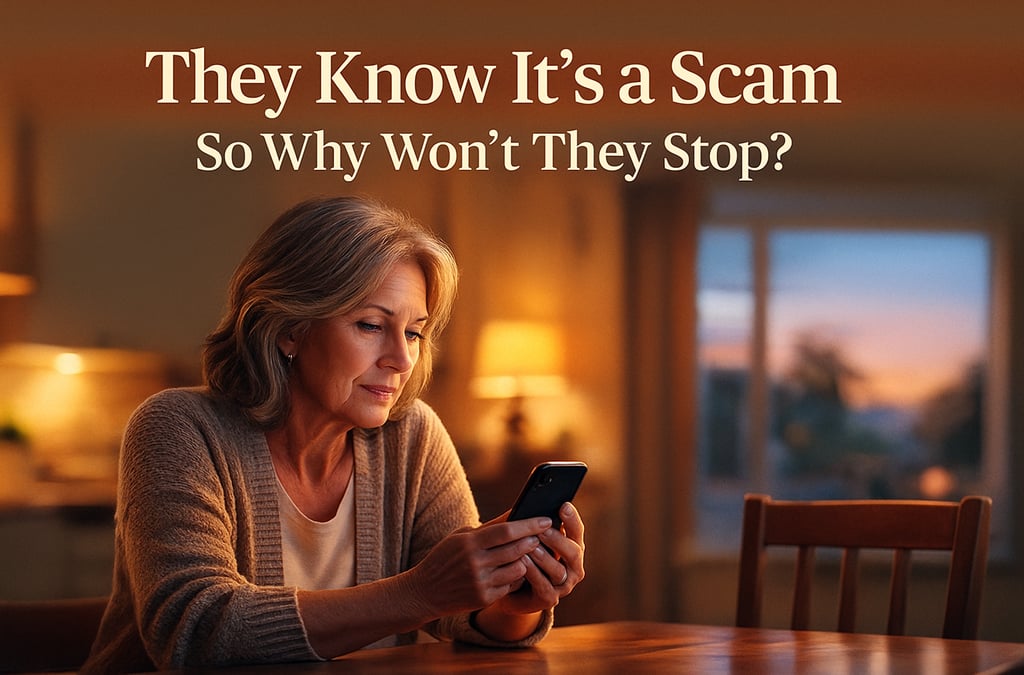
Sarah knows the man she texts every morning isn't real. She's seen the evidence—the reverse image searches her daughter showed her, the inconsistent stories about his supposed military deployment, even the warnings from the FBI website. But every evening at 7 PM, she still picks up her phone and types "Good morning, my love" (he's supposedly overseas, so their time zones are different).
Because for those few minutes each day, she doesn't feel alone.
If you're reading this and thinking "How could anyone be so foolish?"—I understand that reaction. But before you judge, consider this: Sarah is a retired professor with a PhD. She's not unintelligent. She's not gullible. She's simply unbearably lonely, and the emotional companionship this fake relationship provides feels more valuable to her than the truth.
She's also not alone in this behavior. More people than you might imagine continue talking to romance scammers even after discovering the deception. This isn't a story about stupidity—it's a story about the devastating effects of loneliness and the very human need for connection.
This article isn't here to shame anyone. If you're the person still texting that scammer, I see you. If you're the family member desperately trying to help someone you love, I see you too. Let's talk honestly about why this happens, what the real dangers are, and most importantly, how to move toward healthier solutions.
When Loneliness Outweighs Logic
Let's be clear about what we're discussing here. There are generally three categories of romance scam situations:
Category 1: Being genuinely fooled. The person truly believes they're in a real relationship and hasn't recognized the red flags. Once they discover the truth, they immediately cut contact.
Category 2: The gray area of "half-knowing." The person sees warning signs and has doubts, but they push them aside. They tell themselves "maybe it's real" because they desperately want it to be real.
Category 3: Knowing but continuing anyway. This is what we're focusing on today. The person has seen definitive proof that they're talking to a scammer, acknowledges this truth, but chooses to continue the relationship anyway.
That third category shocks people the most. How could someone knowingly participate in their own deception?
The answer lies in understanding just how severe the loneliness epidemic has become. According to recent research, one in ten U.S. adults reported having no close friends or family they could ask for help. The COVID-19 pandemic intensified this isolation exponentially, and many people—especially older adults—never recovered their previous social connections.
Research on romance scam victims reveals something that surprises most people: victims often describe the loss of the relationship as more upsetting than the financial loss. Even after discovering the scam, the emotional attachment remains. That's not foolishness—that's the power of human connection, even when that connection is based on a lie.
One study found that in some cases, victims may suspect or even know the person they're speaking to is a scammer. However, they continue the conversation because it provides companionship and someone to talk to. This doesn't reflect weakness or poor judgment. It reflects a very human need for emotional connection.
The question isn't "How could they be so stupid?" The question is: "What has happened in their life that talking to a scammer feels better than the alternative?"
Understanding the "Why" Without Judgment
To help someone in this situation—or to help yourself—you first need to understand the psychological factors that make this behavior feel not just acceptable, but necessary.
The Loneliness Crisis is Real
Loneliness isn't just an uncomfortable feeling. It's a legitimate health crisis that impacts physical and mental well-being as severely as smoking 15 cigarettes a day, according to some researchers.
Life transitions dramatically increase vulnerability to loneliness:
Widowhood: Losing a spouse after decades together leaves a void that family visits can't fill
Divorce: Especially after long marriages, leaving people suddenly without their primary companion
Retirement: Loss of daily workplace social interactions and sense of purpose
Relocation: Moving away from established friend networks, often to be closer to adult children
Children moving away: Empty nest syndrome combined with limited local connections
Here's what many family members don't understand: Having you visit once a week is wonderful, but it's not the same as having someone to text goodnight to every evening. It's not the same as having someone who asks "How was your day?" It's not the same as feeling like someone is thinking about you.
Your parent or loved one isn't choosing a scammer over you. They're trying to fill a different type of need—daily companionship and the feeling of having a romantic partner who cares about them.
The Chemical Connection
When someone shows us attention and affection, our brains release dopamine and oxytocin—the same chemicals involved in genuine romantic attachment. These are powerful neurotransmitters that create very real feelings of happiness, connection, and bonding.
Here's the crucial part: Your brain doesn't actually distinguish between real and fake attention when it comes to these chemical responses. The dopamine hit from a scammer's "Good morning beautiful, I can't stop thinking about you" text triggers the same response as a genuine romantic interest saying the same thing.
This explains why "knowing better" doesn't necessarily change the behavior. The emotional need and the chemical reward are operating on a level below conscious logic. It's why people can simultaneously think "I know this isn't real" and "But it feels so good when they message me."
The therapeutic aspect matters too. For many people, these daily conversations become a form of emotional regulation. They have someone to tell about their day, someone to share their thoughts with, someone who (appears to) listen without judgment. Even if it's fake, the act of expressing yourself to another person provides psychological relief.
Emotional Attachment Doesn't Disappear With Logic
One of the most revealing studies on romance scams found that even after being shown the scammer's real photograph—often revealing a completely different person, sometimes even a different gender or race than claimed—some victims continued to experience strong emotional attachment to the scammer.
One victim described it this way: "I'd had this guy's picture in my house for a year. I mean, your feelings don't go away. It doesn't work like that at all. Even after seeing who was really writing to me, I still couldn't visualize anyone other than the person in the profile picture."
This happens because victims fall in love with the persona, the character, the fantasy—not the criminal behind it. They've built an entire relationship in their mind with "Mark, the architect working in Dubai" or "Jennifer, the nurse volunteering overseas." The fact that these people don't exist doesn't immediately erase months or years of emotional investment.
This is cognitive dissonance at work: holding two opposing truths simultaneously. "I know the person in the photo isn't real" AND "I have real feelings for the person I've been talking to" can both be true in the victim's mind.
"Better Than Nothing?"
For many people continuing these relationships knowingly, it comes down to a calculated decision: "I know this is fake, but at least someone is listening. At least someone says good morning to me. At least I'm not completely alone."
It's a form of harm reduction in their minds. They're not sending money (or so they tell themselves—more on that danger later). They're just... talking. What's the harm in that?
The companionship, even though fake, temporarily fills the void. It gives them something to look forward to. It provides structure to their day. It makes them feel desired, interesting, valued—feelings that may have been absent from their life for years.
The illusion of intimacy becomes a survival strategy against crushing loneliness.
But here's what's critical to understand: This strategy has serious costs.
Why This Pattern Still Puts You at Risk
Even if you're not sending money yet, knowingly maintaining contact with a romance scammer puts you at serious risk. Let me be direct about these dangers—not to shame you, but because you deserve to understand what you're really dealing with.
The Gradual Erosion of Boundaries
Scammers are professionals at gradually increasing their requests. They're playing a long game. Right now, you might think "I'm safe because I'm not sending money." But that's exactly what they're counting on.
The pattern typically looks like this:
Months 1-3: Pure relationship building, no financial asks
Months 4-6: Small favors (can you look up something for me, can you check if this website works in your country)
Months 6-9: Emotional vulnerabilities shared (family problems, work stress)
Months 9+: The first financial "emergency"
By the time the money request comes, you're so emotionally invested that saying no feels like abandoning someone you care about. The boundary you thought was firm—"I'll never send money"—has been slowly, invisibly eroded over months of daily contact.
Consider this real example: Margaret, a 68-year-old widow, knew "David" was likely a scammer within three months. She told her son she was "just keeping him company" and would never send money. Fourteen months later, she had sent $4,800 in gift cards during three separate "emergencies." Each time, she told herself "just this once." Each time, the relationship had deepened enough that saying no felt impossible.
Information Security Risks
What personal information have you shared during your conversations? Think carefully:
Your full name and age
Your location (city, neighborhood, even specific landmarks you mention)
Your daily routine ("I'm usually home alone on Thursdays")
Your financial situation ("My retirement fund," "My house is paid off")
Your family structure ("My kids live across the country")
Your vulnerabilities ("I haven't dated since my husband died")
Photos of you, your home, your possessions
All of this information can be used for identity theft, targeted phishing attacks, or to make you vulnerable to other scams. The scammer might sell your information to other criminals. They might use what you've shared to craft more convincing scams in the future.
Isolation From Real Relationships
Time is finite. Emotional energy is finite. Every hour you spend texting the scammer is an hour you're not:
Joining a local senior center activity
Calling a friend you've lost touch with
Volunteering somewhere you might meet like-minded people
Taking that class you've been thinking about
Going to that community event your neighbor invited you to
More insidiously, maintaining this fake relationship often creates emotional distance from real people in your life. You're keeping a secret. You might avoid family because you don't want to hear their concerns. You might turn down social invitations because you're waiting for the scammer's evening message.
The fake relationship becomes a substitute for real connection—and a barrier to pursuing it.
The Mental Health Toll
Living a double life is psychologically exhausting. Part of you knows the truth, but you're actively maintaining a fantasy. This creates constant cognitive dissonance and stress.
Many people in this situation experience:
Anxiety (What if they find out I know? What if my family finds out I'm still talking to them?)
Shame (Why can't I stop? What's wrong with me?)
Depression (Is this all I deserve? Is fake companionship the best I can hope for?)
Decreased self-worth (I'm accepting crumbs of fake attention)
You're also teaching yourself a dangerous lesson: that your needs for authentic connection don't matter enough to pursue real solutions. That you're not worth the effort of finding genuine companionship.
The Scammer's Endgame Never Changes
Never forget: This person's goal is to extract money from you. That hasn't changed just because you "know" and are still talking. If anything, your continued engagement after discovering the truth signals to them that you're an even better target—someone so lonely and desperate for connection that you'll accept a known fantasy.
They will ask for money eventually. They're just being patient and waiting for the right opportunity, the right emergency, the right emotional moment when you're vulnerable enough to say yes.
How to Talk to Someone Who Knows But Won't Stop
If you're reading this section, you're probably terrified and frustrated. Someone you love—maybe your mother, your sister, your friend—is knowingly texting a romance scammer, and you don't know how to make them stop.
First, take a breath. I know this is scary. I know you want to shake them and yell "STOP!" But that approach will push them further away and deeper into the relationship with the scammer.
Let's talk about what actually works.
Understanding Why "Just Stop!" Doesn't Work
When someone is using this relationship as a coping mechanism for loneliness, commanding them to stop is like telling someone with insomnia to "just sleep" or someone with depression to "just be happy." It doesn't address the underlying problem.
Aggressive interventions—threats, ultimatums, taking away their phone—will backfire in several ways:
They'll become better at hiding the relationship from you
They'll lose trust in you, cutting off your ability to help
They'll feel even more isolated and turn more toward the scammer
They may choose the scammer over you if forced to pick
You're dealing with someone who has already decided that this fake relationship is valuable enough to maintain despite knowing the truth. That's how profound their loneliness is. Your job isn't to force them to stop—it's to help them find better alternatives and create conditions where stopping becomes possible.
What NOT to Say (And Why It Fails)
Before we get to what works, let's be clear about what doesn't:
"How can you be so stupid?" This creates shame and defensiveness. They'll shut down completely or become angry. Shame has never motivated positive behavioral change—it just makes people feel worse about themselves while continuing the behavior in secret.
"Can't you see they're just using you?" They already know. This statement dismisses their emotional needs as invalid and makes them feel like you don't understand what they're going through. They'll stop confiding in you.
"I'm taking away your phone/computer." Unless they have diagnosed cognitive impairment and you're their legal guardian, this is controlling and infantilizing. It breaks trust and treats them like a child who can't make their own decisions. They'll find ways around it and resent you deeply.
"Stop talking to them right now!" Commands without understanding ignore the root cause. You're treating the symptom (talking to the scammer) without addressing the disease (crushing loneliness). They'll agree to appease you, then continue in secret.
"You're embarrassing the family." This amplifies shame and isolation. Now they feel they're not just lonely and making bad decisions—they're also a burden and embarrassment. This makes them want to hide more, not open up.
"If you don't stop, I won't visit anymore." This ultimatum often backfires catastrophically. You're threatening to remove one of their few real connections as punishment for seeking connection elsewhere. This pushes them toward the scammer, not away.
All of these approaches have one thing in common: they focus on stopping the behavior without addressing the need the behavior is filling.
What TO Say—Effective Approaches
Now let's talk about what actually works. These approaches acknowledge the emotional reality while gently guiding toward healthier solutions.
Approach 1: Validate First, Guide Second
Start by acknowledging the legitimate need they're trying to fill:
"I can see this person makes you feel less lonely. I understand that need. Loneliness is really painful."
"Your feelings are real, even if the person isn't who they claim to be. I get that you've built something meaningful in your mind."
"I'm not here to judge you. I love you, and I'm worried about you getting hurt—emotionally and financially."
This validation doesn't mean you approve of the situation. It means you're acknowledging their emotional reality instead of dismissing it. Once someone feels heard, they're much more likely to listen to your concerns.
Approach 2: Ask Questions (Don't Accuse)
Help them work through their own reasoning by asking thoughtful, non-judgmental questions:
"How does talking to this person make you feel? What do you get out of these conversations?"
This helps them articulate what need is being filled. Listen carefully—their answer will guide you toward real solutions.
"What would you lose if you stopped communicating with them?"
This question reveals what they fear most—usually "being completely alone" or "having no one to talk to daily."
"What do you think they're getting out of this relationship?"
Gentle prompts for critical thinking, without directly accusing.
"If your best friend told you they were in this exact situation, what would you tell them?"
This creates psychological distance and often helps people see the situation more clearly.
Approach 3: Address the Root Cause
This is where you turn the conversation toward solutions:
"I realize I might not have been there enough for you lately. I'm sorry about that. Can we talk about how you've been feeling?"
This takes courage—acknowledging that maybe their loneliness is partly due to their real relationships (including with you) not being enough. But it opens the door to real change.
"It sounds like you're really struggling with loneliness. Let's figure out some better ways to help with that. What would make you feel more connected?"
Make it collaborative. You're not dictating solutions; you're problem-solving together.
"Would you be interested in trying [specific activity, group, or program]? I could go with you the first few times if you'd like."
Concrete, actionable alternatives with your support attached.
Approach 4: Set Boundaries Around Safety (Not Control)
If they're not ready to stop entirely, focus on harm reduction:
"I understand you want to keep talking to them. I can't control that, and I don't want to. But can we agree on some safety rules? Like, you won't send money or personal documents, and you won't give out your home address or financial information?"
This maintains their autonomy while establishing clear safety boundaries.
"Would you be willing to talk to a counselor with me about this situation? Not to fix you, but just to talk through what's going on?"
Offering professional support without making it about them being "broken."
"Can we set up a code word? If you ever feel pressured to do something you're uncomfortable with, text me that word and I'll call you immediately with a convenient 'emergency' to get you out of the situation."
This provides a safety net while respecting their agency.
Approach 5: Offer Alternatives (Not Ultimatums)
Instead of demanding they stop, offer better options:
"What if we found you a pen pal program through the library? You'd still have someone to write to, but it would be vetted and safe."
"There's a book club at the community center that meets twice a week. Would you like to try it with me next Tuesday?"
"I'd love to call or text you more often. Would it help if we set up a regular time—maybe every morning at 9 AM and every evening at 7 PM—when we check in with each other?"
The key is specificity. Not "we should spend more time together" but "I will call you every Tuesday and Thursday at 2 PM. Can we start this week?"
The Conversation Framework—Step by Step
Here's how to structure the actual conversation:
Step 1: Choose the Right Time and Place
Private, comfortable setting (their home, quiet restaurant, park)
NOT right after they've just communicated with the scammer (emotions high)
When they're not already defensive or upset
Allow at least an hour—don't rush this
Step 2: Lead with Love and Concern Open with: "I love you so much, and I need to talk with you about something that's been worrying me. Is now a good time?"
"I've been thinking about how to talk to you about this because I care about you and I don't want you to feel judged. Can we talk openly?"
Set the tone immediately: this is about love, not judgment.
Step 3: Listen More Than You Talk After you've expressed your concern, stop talking and listen. Really listen.
Let them explain their feelings without interrupting with:
Corrections ("But that's not true!")
Rebuttals ("You shouldn't feel that way!")
Solutions ("Well, just do this instead!")
Use active listening phrases:
"What I'm hearing is..."
"It sounds like you're feeling..."
"Tell me more about that."
Your goal right now is understanding, not fixing.
Step 4: Share Your Specific Concerns After listening, share what you're worried about:
"I'm worried about your safety—both emotional and financial. These people are professionals at manipulation."
"I'm concerned about how much time and emotional energy this is taking from you."
"I don't want to see you hurt when they eventually ask for money, or when they disappear."
Be specific about consequences, not dramatic ("You'll lose everything!") but realistic.
Step 5: Collaborate on Solutions Make them part of the solution:
"What do you think would help you feel less lonely in a healthier way?"
"Can we brainstorm some ideas together?"
"What support do you need from me to make a change?"
If they're not ready to stop, focus on harm reduction:
"If you're not ready to stop talking to them yet, can we at least agree on some safety rules?"
Step 6: Follow Up Consistently This is where most family members fail. They have one big conversation, then get busy with life and don't follow through.
Set concrete follow-up plans:
"I'm going to call you Monday, Wednesday, and Friday mornings for the next month. Can we make that our standing time?"
"I'll pick you up next Thursday at 6 PM for that community dinner. I've already marked my calendar."
"I'll research senior groups in your area and send you three options by Saturday."
Then actually do it. Your consistency and reliability are competing with the scammer's daily attention. If you want to win, you need to show up.
Don't abandon them if they're not ready to stop yet. Keep showing up. Keep offering alternatives. Keep being a safe, non-judgmental presence in their life.
Change takes time, and relapse is common. Someone might stop for a week, then restart contact. Don't say "I told you to stop!" Say "I'm here for you. Let's talk about what happened."
When to Seek Professional Help
Sometimes the situation is beyond what family can handle alone. Seek professional intervention if:
Financial red flags:
They've sent large amounts of money (thousands of dollars)
They're draining retirement accounts or taking out loans
They're selling assets or taking out reverse mortgages
They're depleting savings meant for medical care or living expenses
Mental health concerns:
Signs of depression, especially with suicidal ideation
Increased isolation from all friends and family
Personality changes or increased agitation
Refusal to discuss reality, living entirely in fantasy
Cognitive concerns:
Memory problems affecting their judgment
Inability to understand the consequences of their actions
Confusion or disorientation
Other signs of dementia or cognitive decline
Safety concerns:
Planning to travel to meet the scammer (especially overseas)
Scammer has their address and is making threats
They're involved in money laundering (receiving and forwarding funds)
They're receiving packages and reshipping them (likely stolen goods)
Resources to consider:
Therapists specializing in fraud victims: Some therapists specifically work with scam victims and understand the unique psychological dynamics
Elder care advocates: Social workers who specialize in senior issues
Adult Protective Services: Government agencies that investigate elder abuse and exploitation
Financial advisors: Can help secure assets and create safeguards
Support groups: AARP has resources for families dealing with scams
Contact your local Area Agency on Aging for referrals to appropriate services in your area.
If You're Reading This and You Know It's a Scam
Now I want to talk directly to you—the person who's still texting the scammer even though you know the truth.
I'm not going to tell you you're foolish. You're not. You're human, and you're lonely, and those are two of the most relatable experiences in the world. There's no shame in wanting connection. There's no shame in being vulnerable to emotional manipulation when you're isolated.
But I do want you to be honest with yourself about what's really happening here.
Questions to Ask Yourself
Sit with these questions. Don't rush past them or make excuses. Really think about your answers:
Is this person making your life genuinely better, or are they just making loneliness temporarily bearable?
There's a difference. One adds to your life. The other just numbs the pain while keeping you stuck.
What could happen if you redirected this time and emotional energy toward building real connections?
You spend how many hours a day texting this person? Reading their messages? Thinking about them? What if you invested that time in something real instead?
Are you living authentically, or are you maintaining a carefully constructed fantasy?
Think about how much mental energy goes into this. Hiding it from family. Justifying it to yourself. Living in two realities simultaneously. How exhausting is that?
What are you teaching yourself about your worth by accepting fake love as "enough"?
Deep down, are you telling yourself "This is the best I can get"? Because that's a lie, but it's a lie you're reinforcing every day you continue this.
If your best friend or your child was in this exact situation, what would you want for them?
If your daughter told you she was knowingly texting a scammer because she was lonely, what would you tell her? Would you say "That's fine, as long as you're not sending money"? Or would you want so much more for her?
Now ask yourself: Why don't you want that for yourself?
The Truth About "At Least Someone is Listening"
Let me be very direct about something you already know but might be avoiding:
They're not really listening.
They're performing a role designed to extract money from you. Every "good morning beautiful" is calculated. Every "tell me about your day" is a script. Every "I care about you" is a manipulation tactic.
The person on the other end might be a 19-year-old man in a scam center in Nigeria, working from a script, managing 30 conversations at once. Or it might be several different people in shifts, all pretending to be the same person. When you share your feelings, they're not processing them or caring about them—they're scanning for vulnerabilities and opportunities.
That's not companionship. That's performance art designed to rob you.
You deserve someone who genuinely cares about you. Not someone who pretends to care as long as there's money to be made.
Every hour you spend maintaining this fake relationship is an hour you're not spending building real connections. The opportunity cost is enormous. While you're texting a scammer, you're not:
Calling that friend you've been meaning to reconnect with
Joining that group you saw advertised at the library
Signing up for that class you were interested in
Responding to that neighbor's invitation for coffee
Creating space in your life for real, reciprocal relationships
The companionship you're getting is temporary and transactional. The moment you definitively refuse to send money, they'll vanish. Probably without a word. All those months or years of daily conversation will evaporate instantly.
But the emotional damage—the time wasted, the isolation deepened, the lesson learned that you're not worth real connection—that can be lasting.
You deserve better than this. You truly do.
Better Ways to Fill the Void
I know what you're thinking: "But it's not that easy. I can't just snap my fingers and have friends."
You're absolutely right. These alternatives won't give you the instant gratification of a scammer's love-bombing messages. They won't make you feel desired and special within 24 hours. They require effort, vulnerability, and time.
But they will give you something infinitely more valuable: something real, sustainable, and healthy.
Online Communities (The Legitimate Kind)
If you prefer online connection, there are safe alternatives:
Senior-specific forums and social groups:
SilverSneakers Connect (free with many Medicare Advantage plans)
AARP Community online forum
Stitch (social networking specifically for adults 50+)
Meetup.com groups for seniors in your area
Hobby-based online communities:
Ravelry for knitters and crocheters
Goodreads for book lovers with discussion groups
BoardGameGeek for game enthusiasts
Ancestry.com message boards for genealogy interests
Video chat groups: Many libraries, churches, and community centers now offer regular video chat social hours, especially post-COVID. Call your local library reference desk and ask what's available.
Pen pal programs:
Pen Pals for Seniors
Senior Planet pen pal matching
Love for the Elderly (receiving letters from young people)
These provide the written communication you enjoy, but with real people who aren't trying to scam you.
Local Connection Opportunities
Real life connection is powerful. Yes, it requires leaving the house. Yes, it's more effort. But it's also more rewarding:
Senior centers: Most communities have senior centers with daily activities—cards, games, crafts, exercise classes, lunch programs. Many offer transportation if you don't drive. This is one-stop shopping for social connection.
Volunteer work:
Animal shelters (if you love pets)
Libraries (shelving books, literacy tutoring)
Schools (reading to children, mentoring)
Hospitals (greeting visitors, delivering flowers)
Food banks (sorting donations, packing boxes)
Museums (docent programs)
Volunteering gives you purpose, regular social contact, and the good feeling of helping others.
Classes and workshops:
Community college continuing education classes
Library programs (tech classes, language learning, crafts)
Art studios (painting, pottery, photography)
Cooking schools
Community theater groups
Religious or spiritual communities: Even if you haven't been to church/temple/mosque in years, most welcome returning members and newcomers. Many have senior groups, social events, and volunteer opportunities.
Exercise-based social groups:
Walking groups (many parks have morning walking groups)
SilverSneakers classes at gyms
Aqua aerobics at community pools
Tai chi in the park
Yoga classes for seniors
Technology-Assisted Real Connection
Use technology to enhance real relationships, not replace them:
Scheduled video calls with family: Don't wait for family to call. Set up standing appointments. "Can we video chat every Sunday at 4 PM?" Having it scheduled means something to look forward to and reliable connection.
Online courses with discussion components:
Coursera, edX, Khan Academy (many free courses)
Great Courses Plus
CreativeLive
Local community college online offerings
Choose courses with discussion boards or live components where you interact with other real students.
Legitimate dating sites (with education): If you genuinely want romantic connection, use legitimate dating sites designed for your age group:
OurTime (specifically for 50+ singles)
SilverSingles (for mature adults)
eHarmony (has good matching for older adults)
BUT: Take a class first on online dating safety, or work with a family member to learn red flags.
Social media groups for specific interests: Facebook groups for your specific hobbies, local community events, alumni groups from your school or former workplace. Real people sharing genuine interests.
Professional Support
There's no shame in getting professional help for loneliness:
Therapy: Many therapists specialize in life transitions, grief, and loneliness in older adults. You can find therapists who offer video sessions if transportation is difficult. Psychology Today has a "Find a Therapist" tool where you can filter by specialty and insurance.
Support groups:
GriefShare groups for those who've lost spouses
DivorceCare for those processing divorce
Support groups for specific chronic illnesses
Caregiver support groups
Depression/anxiety support groups
Check with local hospitals, hospice organizations, and religious institutions for free support groups.
Social workers specializing in senior issues: Contact your local Area Agency on Aging. They often have social workers who can connect you with resources, visit regularly, and help you build social connections.
Legitimate companionship services: Some areas have professional services where you can pay for companionship—someone to have coffee with, take walks with, play cards with. These are vetted, background-checked individuals providing a legitimate service.
Look for:
Home Instead Senior Care (companionship services)
Visiting Angels
Senior Helpers
Self-Connection Practices
Sometimes, learning to be comfortable with yourself reduces the desperate need for external validation:
Journaling: Morning pages (three pages of free writing each morning) or gratitude journaling can help process emotions and reduce the frantic need for someone else to listen.
Creative hobbies: Painting, drawing, writing, playing music, crafting—these provide flow states where loneliness recedes. Join a class or group to make it social too.
Pet adoption or fostering: If you're able, a pet provides non-judgmental companionship, routine, and unconditional love. Fostering for a shelter gives you this benefit while helping animals in need. Many shelters have senior-to-senior programs matching older adults with older pets.
Gardening: Both the activity itself and community gardens provide purpose and social connection.
Meditation and mindfulness: Apps like Calm, Headspace, or Insight Timer can help you develop a healthier relationship with solitude. Many offer free options.
Remember: These alternatives won't work instantly. The scammer gives you immediate gratification—immediate response, immediate validation, immediate feeling of being wanted.
Real connection takes longer to develop. But it's real. And that makes all the difference.
When You're Ready to Stop
Maybe you're not quite ready yet. Maybe you're still on the fence. That's okay. But save this section for when you are ready, because that moment will come.
How to End the Contact
When you decide to stop, here's what to do:
Block and delete everything. Don't send a goodbye message. Don't explain. Don't give them closure. They don't deserve it, and it gives them an opportunity to manipulate you back.
Block their number/email/WhatsApp/Facebook—everything. Delete the contact entirely. Delete all photos, all saved messages, everything. Make it impossible to contact them impulsively during a weak moment.
Expect grief—it's normal. You're going to feel sad. You might cry. You might feel like you've lost someone you cared about. That's completely normal and valid, even though you know the person wasn't real.
You've lost a daily ritual. You've lost the fantasy you built in your mind. You've lost the feeling of being wanted. It's okay to mourn that loss while simultaneously knowing it was necessary.
Give yourself grace. You're not stupid for falling for this. You're not weak for having continued it. You were vulnerable and lonely, and someone exploited that. The shame belongs to them, not you.
Don't beat yourself up about the time you "wasted." You were coping the best way you knew how at the time. Now you know better, and you're doing better.
Focus on what you learned. What did this experience teach you about yourself? What needs were you trying to meet? How can you meet those needs in healthier ways going forward?
Build your support system BEFORE cutting them off. This is crucial. If you cut off the scammer while you're still isolated, you'll be even more vulnerable to relapse or to a new scammer.
Before you block them, make sure you have:
At least one regular social activity scheduled weekly
Daily contact with someone real (even if just a scheduled phone call)
A plan for your lonely moments
Someone you can call when you're tempted to unblock them
Preventing Relapse
Relapse is common. Don't be surprised if you're tempted to unblock them or if you find yourself missing the conversations. Prepare for this:
Recognize your vulnerable moments: When are you most likely to want to reach out to them?
Holiday loneliness (birthdays, anniversaries, major holidays)
Evening hours (especially times you used to message them)
After stressful or sad events
When you see something that reminds you of them
During periods of extra isolation (illness, bad weather)
Have a plan for each trigger: For holidays: Make plans in advance. Volunteer. Visit family. Join a community event.
For lonely evenings: Have a specific activity planned. Call a friend. Watch a specific show. Take a walk. Don't leave yourself with empty time.
For stress or sadness: Have a list of three people you can call instead.
Stay busy during usual contact times: If you always texted them at 7 PM, plan something else for 7 PM. Take a class, call a friend, go for a walk—actively replace that time.
Delete ALL reminders: No photos saved. No screenshots of messages. No souvenirs of the fantasy. Keeping this stuff makes relapse likely.
Fill the void proactively, not reactively: Don't wait to feel lonely and then try to fix it. Build your social support now, while you're motivated, so it's there when you need it.
If you do relapse—if you unblock them and start messaging again—don't give up. Stop again as soon as you recognize what you're doing. Every attempt at stopping is practice for the final successful attempt.
You Deserve Real Connection
Whether you're the person still texting the scammer, or the family member desperately trying to help, I want you to hear this:
This situation doesn't define you.
To the person in the relationship: Your loneliness is real and valid. Your need for connection is human and understandable. The fact that you ended up in this situation doesn't mean you're foolish—it means you were vulnerable and someone exploited that. The shame belongs to them, not you.
To the family member: Your frustration is valid. Your fear for your loved one is understandable. The fact that they're not stopping immediately doesn't mean they don't value you—it means they're struggling with something deeper than logic can fix.
The fact that you're reading this—whether you're the person still texting the scammer or the family member desperately trying to help—means part of you wants something better. That's the part worth listening to.
Loneliness is temporary. With effort and support, it can be addressed. But the lessons you're teaching yourself by accepting fake companionship—that you're not worth real connection, that you should accept crumbs of attention, that you deserve only what you can get from strangers online—those lessons can last much longer if you don't challenge them.
You have options. Real options. Healthier options. They require more effort than maintaining the fantasy, yes. But they offer something the fantasy never can: genuine connection with real humans who actually care about you.
To the family members reading this: Thank you for caring enough to try to understand. Thank you for not giving up. Your loved one needs you more than they can probably express right now. Keep showing up. Keep being that reliable, real presence in their life. You might be the counter-example that eventually helps them see they do deserve better.
Real love doesn't require you to pretend. Real companionship doesn't come with strings attached or the risk of financial ruin. Real connection doesn't cost you your peace of mind, your bank account, or your self-respect.
You deserve all of that—and it's waiting for you on the other side of this decision.
The scammer will disappear eventually anyway. They always do. The only question is: Will you have built real connections by then, or will you still be alone, looking for the next fantasy to fill the void?
Choose real. It's harder. It takes longer. But it's worth it.
You're worth it.
If you or someone you love is struggling with recovery after a romance scam, consider downloading our Reclaiming You: A Workbook for Romance Scam Survivors. This comprehensive guide provides exercises and strategies for healing emotionally and rebuilding your self-worth after a scam.
For more information about romance scams and how to protect yourself, subscribe to our newsletter for weekly tips, updates, and support resources.
© 2025. ScamProofLove. All rights reserved — Protect your heart, your wallet, and your peace of mind.
support@scamprooflove.com