
20 Questions That Will Expose a Romance Scammer Every Time
With AI deepfakes making romance scams nearly undetectable, knowing the right questions to ask could save you thousands—or your entire life savings. These 20 strategic questions will expose even the most sophisticated scammers before they can hurt you.
11/8/202511 min read
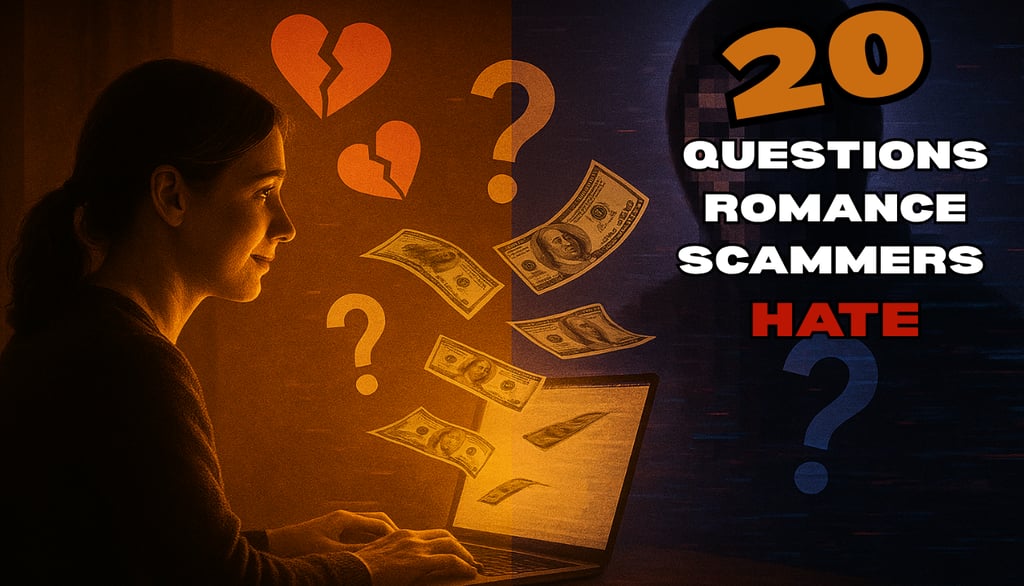
I've spent time researching romance scams, speaking with survivors, and analyzing the tactics these criminals use. What breaks my heart most isn't just the money lost—it's the shattered trust, the self-doubt that lingers, and the whispered question: "How did I miss the signs?"
Here's what I've learned: You didn't miss the signs because you were foolish. You missed them because scammers are professionals at deception. They've refined their scripts over thousands of victims. They know exactly which words trigger trust and which emotions override logic.
But scammers, no matter how sophisticated, have one fatal weakness: they can't know everything about a life they've never lived. They can research a city on Google, but they can't recall the smell of rain on its streets. They can claim to have graduated from a university, but they can't remember the professor who changed their worldview. They can copy photos of someone else's children, but they can't tell you about that Tuesday morning when everything went wrong at breakfast.
The questions below aren't just conversation starters—they're carefully designed to expose the gaps between a fabricated story and a lived experience. Used thoughtfully, they'll help you distinguish between someone building a genuine connection and someone building a con.
Understanding the Modern Romance Scammer
Before we dive into the questions, you need to understand what you're up against. Today's romance scammers operate with tools that seemed impossible just two years ago.
In 2024 and 2025, authorities across Hong Kong, Taiwan, and Southeast Asia have dismantled sophisticated criminal syndicates using AI-powered deepfake technology for live video calls. These weren't pre-recorded clips—they were real-time face-swapping applications that allowed scammers to appear as attractive, trustworthy people during video chats. One operation alone stole over $46 million from victims who were certain they'd video-chatted with their romantic partner.
Beth Hyland from Michigan lost $26,000 to a scammer who used deepfake video calls. She saw "Richard" on camera multiple times. "When I saw him on video, it was the same as the pictures," she told investigators. The technology was convincing enough to bypass what used to be our most reliable verification method.
A South Korean woman lost $50,000 to someone impersonating Elon Musk, complete with AI-generated photos and a deepfake video call where "Musk" told her he loved her. Romance scam losses topped $1.3 billion in 2024 alone—and experts estimate only 7% of scams are actually reported due to shame and embarrassment.
This isn't meant to scare you. It's meant to prepare you. Because while the technology has evolved, the human weaknesses scammers exploit remain the same: our longing for connection, our willingness to trust, and our reluctance to believe someone could be that cruel.
The Strategic Approach to Asking Questions
Here's what most articles about spotting scammers get wrong: they tell you to "ask questions" without explaining how to ask them. The way you phrase these questions matters enormously.
Don't interrogate. Weave these questions naturally into conversations over days or weeks. Real relationships develop through curiosity, not through depositions. The goal isn't to catch someone in a lie on question three—it's to accumulate a pattern of inconsistencies, evasions, and gaps that reveal the truth over time.
Pay attention not just to their answers, but to how they answer. Do they deflect? Change the subject? Respond with vague platitudes? Get defensive or angry at reasonable questions? These reactions often tell you more than the words themselves.
Questions About Specific Locations
1. "What's the one restaurant in your hometown you'd take me to on our first date there?"
Everyone has a place. The corner diner where the waitress knows their order. The hole-in-the-wall taco shop that doesn't look like much but serves the best carnitas in the city. The Italian place where their parents had their first date.
A scammer will say "I don't know, it's been so long" or name a chain restaurant like McDonald's or Starbucks. Someone who actually lived there will light up describing a specific place—and they'll tell you why it matters to them.
2. "Tell me about your route to work. Do you take the highway or surface streets?"
This seems mundane, but it's brilliant. Someone who actually commuted to a specific workplace can describe this journey in detail—the intersection where traffic always backs up, which lane to be in for the exit, where the good coffee shop is on the way.
A scammer might say they work somewhere, but they can't describe the physical experience of getting there. Watch for vague responses or sudden topic changes.
3. "What did your neighborhood smell like after it rained?"
This is one of my favorite questions because it's so specific that it's almost impossible to fake. We all have sensory memories of the places we've lived. Petrichor mixed with honeysuckle. Wet asphalt and blooming jasmine. The musty smell from old buildings.
Scammers often give generic answers or skip sensory details entirely. Real people recall these memories vividly—and usually with unexpected specificity.
4. "Which hospital were you born at, and what part of the city is it in?"
Most people know this answer. It's in family stories, brought up on birthdays, or they've driven past it a hundred times. If someone claims to be from Chicago but can't name which hospital or what neighborhood it's in, that's a significant red flag.
Scammers will often say "home birth" or claim they don't remember—which is possible, but combined with other evasive answers, forms a pattern.
Questions About Lived Experience
5. "What was the name of your elementary school, and what was the school mascot or colors?"
This is incredibly hard to fake. Everyone remembers their elementary school. The name is burned into your memory from writing it on papers for years. Most people can recall the mascot, school colors, or the name of at least one teacher.
Someone fabricating a background might know the city they're "from," but they won't know the specific elementary schools in that district.
6. "Tell me about your best friend from childhood. How did you meet?"
Real friendships have origin stories. "We met in Mrs. Anderson's third-grade class when she defended me from a bully." "Our parents were neighbors; we learned to ride bikes together."
Scammers struggle with this question because friendship stories contain dozens of small, specific details that can't be researched on Google. Watch for vague responses like "We met at school" without any texture or detail.
7. "What's the most embarrassing thing that happened to you in high school?"
Everyone has a story. The time you tripped during a presentation. When your voice cracked while asking someone to prom. The day you showed up wearing the exact same outfit as your teacher.
These stories are self-deprecating, specific, and often funny in retrospect. Scammers typically avoid vulnerability or give obviously fabricated "embarrassing" stories that are actually humble-brags.
8. "What did your family do for holidays when you were growing up? Tell me about a specific memory from one of them."
This question is powerful because holiday traditions are deeply personal and culturally specific. Real people can describe a specific Thanksgiving—the year the turkey burned, when Grandma got too drunk and started singing, when cousin Joey announced his engagement.
Scammers give generic descriptions of holidays without specific memories attached. "We had turkey and spent time with family" tells you nothing. A real memory has names, conflicts, sensory details, and imperfect moments.
Questions That Test Real-Time Authenticity
9. "Can you send me a selfie right now holding up three fingers?"
This is the modern version of "holding today's newspaper." Scammers use stolen photos or AI-generated images. They can't produce custom photos on demand.
If they refuse, make excuses, or the photo they send looks staged or doesn't match what you asked for, you have your answer. Real people will find this request slightly odd but will comply without drama.
10. "Can we video call right now? I want to see you stick your tongue out and make a funny face."
Here's the thing about even sophisticated deepfake technology in 2024-2025: it still struggles with certain movements. Asking someone to stand up, walk around the room, put their hands on their face, or make exaggerated facial expressions can reveal deepfake glitches.
If they consistently refuse video calls, that's suspicious. If they agree but then the call "doesn't work" repeatedly, that's even more suspicious. And if you do get on a video call, pay attention to whether they keep their head very still and avoid certain movements.
11. "Call me right now from your phone, not through the app."
Romance scammers rarely give out real phone numbers. They use burner phones, Google Voice numbers, or they keep all communication within apps where they have more control.
When asked for a phone number, they'll say they're traveling, their phone was stolen, international rates are too expensive, or they're waiting for a new phone. There's always an excuse.
12. "Let's meet this weekend. I'll come to you—just tell me where."
This is the ultimate test. A scammer will never meet you in person because they're not who they claim to be. They might not even be in the country they claim.
They'll agree enthusiastically, then have a crisis that prevents them from meeting. Then another crisis. Then another. The pattern becomes clear: they'll talk endlessly about meeting "someday" but that day never comes.
Questions About Work and Career
13. "Walk me through a typical day at work. What time do you get there, what's your first task, who do you usually see?"
Someone who actually works in a specific role can describe their day in granular detail. They know what time the morning standup meeting is, who always shows up late, what they grab for lunch, the quirks of their workspace.
Scammers give movie-like descriptions of work: vague, glamorous, or dramatic. "I work on the oil rig" doesn't tell you anything. But "I start my day at 5 AM with equipment checks, then brief the crew about the day's drilling plan" has the texture of reality.
14. "What's the most frustrating thing about your job?"
Everyone complains about work. The software that crashes constantly. The coworker who never refills the coffee pot. The client who emails at midnight expecting immediate responses.
If someone describes their job as perfect with no frustrations, they're likely not doing that job. Real work includes annoying but specific problems.
15. "Can you show me your company on LinkedIn or send me the link to your work profile?"
This is direct, and you should present it that way: "I'd love to know more about your company and what you do. Can you share your LinkedIn?"
Scammers will claim they don't use LinkedIn, their account was hacked, they're not allowed to have social media due to their job, or they're not tech-savvy. These might be legitimate reasons, but combined with other red flags, they form a pattern.
Questions About Money and Practicalities
16. "If you needed to show me proof of identity to make a wire transfer happen, what form of ID would you provide?"
This is brilliant because it turns the tables. If they're asking you to send money and you say "My bank needs your ID to process the wire," a legitimate person would understand. A scammer will become evasive, angry, or make this your problem.
"If you loved me, you'd trust me" or "I can't believe you're asking for this" are manipulation tactics designed to make you feel guilty for having reasonable boundaries.
17. "What's your Social Security number?" (or national ID number)
Only ask this if they've already asked you for money and you're testing their reaction. Present it as a banking requirement: "My financial advisor needs this information to complete the transfer."
They will never provide this. They'll have immediate excuses, get angry, or suddenly claim they found another way to solve their problem.
18. "Let me book us a flight to meet in person right now. What airport is closest to you?"
Offer to handle all the logistics and expenses. This removes their excuse about not having money to travel. Watch what happens.
A real person will either accept gratefully or, if they have legitimate concerns about safety, suggest meeting in a public place for the first time. A scammer will find reasons why even this won't work.
Questions About Their Digital Presence
19. "Can I see your other social media accounts? What's your Instagram handle?"
Real people have digital footprints. They have friends who tag them in photos, years of posts, comments from family members, check-ins at actual locations.
Scammers either have no social media presence or accounts created very recently with very few connections. The photos won't have normal engagement—no comments from friends, no tagged locations, no mundane posts about daily life.
20. "Let me talk to one of your friends or family members, just so I know you're real."
This might seem extreme, but it's actually not unreasonable when someone is asking you to send money or make a significant emotional commitment. A real person who cares about you would understand your need for reassurance.
A scammer will refuse, make excuses, or suddenly become offended that you don't trust them. But here's the truth: trust without verification isn't love—it's naivety, and criminals count on you confusing the two.
What To Do If You Confirm Your Suspicions
If you've asked these questions and the answers reveal a pattern of deception, here's what you need to do:
Stop all communication immediately. Don't confront them, don't ask for explanations, don't give them a chance to manipulate you further. Block them on every platform.
Do not send any more money. If you've already sent money, contact your bank immediately. Depending on the transfer method, you may be able to reverse some transactions.
Report them. Report their profile to the dating site or social media platform. File a report with the FBI's Internet Crime Complaint Center (IC3) and the Federal Trade Commission. Report them to your local police. Even if you can't get your money back, your report helps build cases against these criminals.
Reach out for support. Contact organizations like AARP's Fraud Watch Network or the National Center for Victims of Crime. Consider speaking with a therapist who specializes in fraud trauma—yes, that's a real specialization, because the psychological impact is profound.
Forgive yourself. This is perhaps the most important step. You weren't stupid. You weren't naive. You were human—and these criminals are professionals at exploiting human nature. They've refined these tactics across thousands of victims. The shame belongs to them, not to you.
The Truth About Modern Romance Scams
Here's what keeps me up at night: As I write this in late 2024, AI tools are becoming more sophisticated every month. The deepfakes that look obviously fake today will be virtually undetectable next year. The chatbots that occasionally use odd phrasing will soon communicate flawlessly.
But there's hope in this arms race. While technology evolves, human nature remains constant. The questions above work not because they rely on technical detection methods, but because they test for the presence of an actual lived experience. And no AI, no matter how sophisticated, can fabricate the texture of a real life.
A scammer can research facts about Chicago, but they can't describe what it felt like waiting for the Red Line on a February morning when the wind off Lake Michigan cut through every layer. They can claim to work in marketing, but they can't describe the specific frustration of trying to get a campaign approved by seven different stakeholders who all want different things.
Life is specific. Life is detailed. Life is messy and mundane and filled with moments that don't make sense to anyone but you. And that's what these questions test for—not facts, but the accumulated texture of existence.
If you're reading this because you're wondering about someone you've met online, trust that instinct. That small voice of doubt is your intuition trying to protect you. Don't silence it with wishful thinking. Instead, ask these questions. Wait for real answers. Give yourself permission to walk away if the answers don't come.
You deserve real love—messy, imperfect, physical, and true. Not the algorithmic simulation of it that arrives in carefully crafted text messages from someone who'll never get on a plane to see you.
The right person won't make you feel crazy for asking questions. They'll understand your caution because they'll want you to feel safe. And on the day you finally meet them—in person, in real life, in three dimensions—you'll know the difference between what you had before and what you have now.
That difference is everything.
Get your copy of The Romance Scam Red Flags Checklist - Your free guide to spotting scammers before they break your heart and empty your wallet.
© 2025. ScamProofLove. All rights reserved — Protect your heart, your wallet, and your peace of mind.
support@scamprooflove.com