
How to Verify Someone's Identity Online Before You Meet
Learn how to verify someone's identity online before meeting them in person. Discover 8 practical verification methods that expose romance scammers, including video call tricks, reverse image searches, and social media cross-checks that work even against AI-powered fraud.
11/13/202511 min read
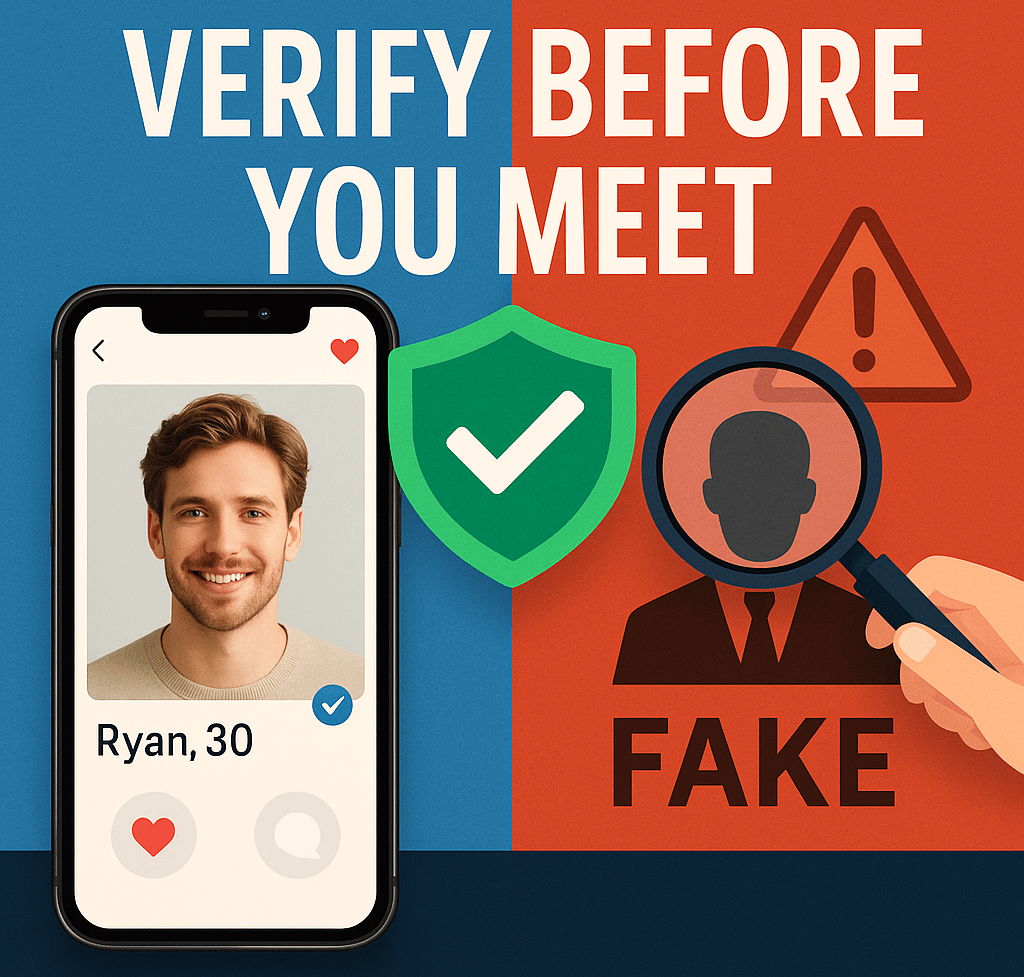
Don't let romance scammers fool you with fake profiles and AI-generated personas. Learn practical verification methods to confirm someone's real identity before meeting in person or sending money.
Trust But Verify: Why Identity Checks Save Relationships (and Bank Accounts)
The advice used to be simple: "Just ask for a video call." Unfortunately, with deepfake technology and pre-recorded video loops becoming more accessible, scammers have found ways around even this safeguard. Today's romance fraud landscape demands a more sophisticated approach to verification—one that combines multiple methods to build confidence that the person you're talking to is actually who they claim to be.
Romance scams cost Americans over $1.3 billion in 2024, with victims losing a median of $2,000 per incident. The emotional devastation often exceeds the financial loss. But here's the encouraging news: scammers rely on avoiding verification at all costs. When you implement proper identity checks, legitimate people will cooperate readily while scammers will make excuses, delay, or disappear entirely.
This guide provides practical, actionable verification methods you can start using immediately to protect yourself while building genuine online connections.
Understanding the Stakes: What Verification Prevents
Identity verification isn't about being paranoid—it's about being smart. When you verify someone's identity before deepening a relationship, you protect yourself from:
Financial Exploitation Romance scammers work toward one goal: convincing you to send money. Whether they claim emergency medical expenses, travel complications, or investment opportunities, unverified online relationships create the perfect setup for financial fraud.
Emotional Manipulation Catfishers and scammers invest weeks or months building fake relationships. The longer you interact with someone whose identity you haven't verified, the harder it becomes to walk away when red flags appear. Early verification cuts losses before emotional investment deepens.
Identity Theft Sharing personal information—your full name, address, workplace, family details, financial data—with an unverified stranger puts you at risk for identity theft. Scammers compile detailed victim profiles that enable multiple fraud schemes.
Physical Safety Risks Meeting an unverified person in real life poses obvious dangers. Even those who aren't financial scammers might misrepresent their marital status, criminal history, or intentions.
The Multi-Layer Verification Approach
No single verification method provides complete certainty. Scammers know the common tricks and prepare counterstrategies. The solution? Use multiple verification layers. Each additional check increases the difficulty for scammers exponentially while remaining simple for legitimate people.
Layer 1: Video Call Verification (With a Twist)
Video calls remain valuable verification tools—but only when done correctly. Scammers now use pre-recorded videos, deepfake technology, and face-swapping apps to fake video interactions. Here's how to verify effectively:
Request Specific, Spontaneous Actions Don't settle for a regular video chat. During the call, ask your conversation partner to perform specific, immediate actions that pre-recorded videos can't accommodate:
"Touch your left ear with your right hand"
"Hold up three fingers, then two, then five"
"Turn your head completely to the left, then right"
"Say this specific sentence: [insert random phrase]"
"Stand up and take two steps backward"
"Hold today's newspaper or phone showing today's date"
Legitimate individuals comply without hesitation. Scammers using fake video will claim technical difficulties, freeze their screen, or make excuses about why they can't perform these actions.
Watch for Deepfake Warning Signs Even sophisticated deepfakes exhibit telltale signs:
Unnatural head movements or stiff neck positioning
Face morphing or blurring when moving quickly
Audio that doesn't quite sync with lip movements
Static backgrounds that don't change naturally
Lighting that doesn't shift naturally as they move
Repetitive gestures or phrases that seem to loop
Multiple Video Sessions Schedule several video calls at different times. Pre-recorded videos have finite footage. If you notice identical gestures, phrases, or movements repeating across calls, you're likely viewing recorded content.
Look for Environmental Consistency Ask to see different rooms in their home, or request calls from different locations they've mentioned (work, gym, friend's house). Scammers typically have limited video footage available and will make excuses to avoid showing new environments.
Layer 2: Reverse Image Search
Reverse image searching remains one of the most effective verification methods because most scammers still use stolen photos rather than generating entirely new AI images.
How to Conduct a Reverse Image Search:
Save their profile photos to your device
Visit Google Images (images.google.com)
Click the camera icon in the search bar
Upload the saved image or paste the image URL
Review the results for other appearances of the same photo
Alternative Search Engines:
TinEye (tineye.com): Specializes in finding image variations
Yandex Images: Often finds results Google misses
Social Catfish: Purpose-built for verifying online dating profiles
What to Look For:
Photos appearing on multiple dating profiles with different names
Images linked to modeling portfolios or stock photo sites
Pictures associated with different people on social media
Images appearing in scam warnings or victim reports
Important Note: Finding no results doesn't automatically mean the profile is legitimate. AI-generated images and freshly stolen photos won't appear in reverse searches. That's why you need multiple verification layers.
Layer 3: Social Media Cross-Referencing
Legitimate people maintain consistent digital footprints across platforms. Scammers typically create minimal, recently established profiles with suspicious characteristics.
Check Multiple Platforms Ask for their Instagram, Facebook, LinkedIn, or Twitter handles. Real people usually have:
Accounts established months or years ago
Regular posting history spanning multiple dates
Authentic-looking friend lists with reciprocal interactions
Photos showing them with other people in various settings
Comments and interactions from others on their posts
Consistency in personal details across all platforms
Red Flags to Watch For:
Brand new accounts (created within the last few months)
Minimal friends or followers (under 50, especially if they're attractive)
No photos showing the person with friends or family
Generic posts without personal details or local references
Photos that look professionally shot or too perfect
Accounts that only follow but aren't followed back
Missing mutual friends despite claiming to live in your area
Ask About Specific Posts Reference specific photos or posts on their social media. "I saw your photo at the beach last summer—where was that taken?" Scammers often can't provide details about "their" photos because they stole them.
Layer 4: Video Message Request
Different from a video call, ask them to record a personalized video message specifically for you. This simple request defeats both pre-recorded video loops and stolen content.
Effective Video Message Requests:
"Can you record a quick video saying hello and mentioning my name?"
"Would you mind sending a short video holding up a sign with today's date and my username?"
"Could you record yourself saying this phrase: [insert specific unusual sentence]?"
Legitimate people comply within hours. Scammers will delay, claim technical problems, or refuse entirely because they can't produce customized content matching the stolen identity they're using.
Layer 5: Phone Number and Location Verification
Phone numbers provide valuable verification opportunities, though they're easier to fake than they used to be.
Google Voice and Burner Apps Be aware that scammers commonly use Google Voice, TextNow, Burner, or similar apps that provide temporary numbers disconnected from their real identity. These services create numbers that:
Often have area codes that don't match their claimed location
Don't connect to real carrier billing information
Can be abandoned instantly without consequences
Phone Call Verification Steps:
Request actual phone conversations, not just text messages
Note whether the area code matches their stated location
Listen for background noises consistent with their claimed environment
Ask spontaneous questions requiring immediate, unscripted answers
Have multiple calls at different times to verify consistency
Location Consistency Checks Cross-reference claims about where they live with:
Local references (restaurants, landmarks, weather, recent local events)
Time zone consistency in message timing
Knowledge of their claimed city beyond what Google provides
Realistic commute times for their supposed job and home location
Layer 6: Background Check Services
For relationships progressing toward serious commitment or in-person meetings, formal background check services provide another verification layer.
Available Services Include:
Social Catfish (socialcatfish.com) Purpose-built for verifying online dating profiles. Searches social media, public records, and known scam databases.
BeenVerified Provides comprehensive public records searches including criminal history, addresses, and associated people.
Spokeo Aggregates information from social media, public records, and online profiles.
DateID Specifically designed for dating app verification, providing background information visible to potential matches.
Important Considerations:
Most services charge fees ranging from $1-$40 per search
Information accuracy varies by service and location
Public records take time to update
No service provides 100% complete information
Privacy concerns exist around providing someone's full details
Use background checks as confirmation after other verification methods raise your confidence, not as the sole verification method.
Layer 7: Third-Party Verification Through Mutual Connections
If they claim to live in your area or work in your industry, finding mutual connections provides powerful verification.
Verification Through Networks:
"You said you work at [Company]—do you know [Person]? They work there too."
"You mentioned attending [University]—what year did you graduate? Do you know [Professor] who taught [Subject]?"
"You're from [City]—have you been to [Local-Only Spot]? What did you think?"
Scammers typically can't navigate these specifics because their entire identity is fabricated. Real people discuss mutual connections naturally.
Layer 8: Time-Stamped Photo Requests
Ask for current photos with specific elements proving they're recent and authentic.
Effective Requests:
"Could you send a photo of yourself holding up a piece of paper with today's date and my name?"
"Would you mind taking a selfie right now next to [specific object you can see on their video call]?"
"Can you send a photo from the coffee shop you mentioned visiting this morning?"
These requests defeat stock photos, stolen images, and AI-generated content because they require real-time, customized responses.
Common Excuses Scammers Make to Avoid Verification
Understanding typical scammer excuses helps you recognize when someone is evading legitimate verification requests:
Video Call Excuses:
"My camera is broken"
"I'm too shy to video chat yet"
"The internet is too slow where I'm working"
"I don't have a computer with a camera"
"Let's wait until we know each other better"
Reality Check: Nearly everyone has a smartphone with video capability. Internet speeds sufficient for messaging are sufficient for video. Shyness doesn't prevent someone from spending 60 seconds on video with someone they claim to have feelings for.
Photo Request Excuses:
"I don't like taking selfies"
"My phone camera is terrible"
"I'll send one later when I look better"
"Why don't you trust me?"
Reality Check: Someone genuinely interested in building trust takes 30 seconds to snap a photo. Turning verification requests into "trust issues" is manipulation.
Background Information Excuses:
"I'm a private person"
"I don't use social media much"
"Why do you need all this information?"
"Are you investigating me?"
Reality Check: Basic information like a LinkedIn profile or Instagram account doesn't violate privacy. Legitimate people understand verification is reasonable before in-person meetings.
When Verification Should Happen
Verification timing matters. Request verification:
Before Sharing Personal Information Don't provide your real name, workplace, address, or other identifying details until you've completed basic verification.
Before Emotional Investment Deepens Verify identity within the first few conversations. The longer you wait, the harder it becomes to remain objective.
Definitely Before Meeting in Person Complete thorough verification before any face-to-face meeting, regardless of how long you've been communicating.
Absolutely Before Sending Money This should be obvious, but it bears repeating: never send money to someone whose identity you haven't thoroughly verified through multiple methods—and even then, legitimate romantic interests don't ask for money.
Before Sharing Intimate Content Never share private photos, videos, or personal information with unverified contacts. This content can be used for extortion or published online.
What Legitimate People Do
Recognizing how real people respond to verification requests helps you distinguish genuine profiles from scammers:
Legitimate individuals:
Comply with verification requests quickly and without complaint
Understand why you want to verify identity
Provide consistent information across multiple platforms
Have established digital footprints predating your connection
Discuss specifics about their lives, jobs, locations, and interests
Introduce you to their friends and family relatively early
Make concrete plans to meet that actually happen
Never ask for money, regardless of circumstances
Scammers:
Delay verification with excuses
Become defensive or angry about verification requests
Provide inconsistent information
Have minimal or recently created online presence
Speak in generalities without specific personal details
Keep you separate from other parts of their life
Cancel or postpone meeting plans repeatedly
Eventually ask for financial assistance
Special Considerations: Dating App Verification Features
Many dating apps now offer internal verification systems. While helpful, don't rely on them exclusively:
Tinder Blue Checkmark: Requires submitting government ID and matching selfie. Provides reasonable confidence but doesn't prevent all fraud.
Bumble Photo Verification: Users take real-time selfies matching specific poses. Confirmed verified profiles get badges.
Hinge Selfie Verified: Video selfie verification matching profile photos.
Important Limitations:
Verification badges confirm someone controls the profile, not that they're truthful about themselves
Scammers can verify fake profiles using stolen IDs
Verification doesn't check criminal history or marital status
Some apps make verification optional, so unverified doesn't necessarily mean fake
Use app-internal verification as one data point among many, not as comprehensive confirmation.
Red Flags That Should Stop Verification Attempts
Some warning signs are so serious you shouldn't bother with verification—just block and move on:
Immediate Red Flags:
Asks for money before meeting (for ANY reason)
Requests gift cards, cryptocurrency, or wire transfers
Claims to need help with medical expenses, legal fees, or travel costs
Refuses all forms of verification while professing strong feelings
Pressures you to decide quickly or "prove your love"
Asks for your banking information, passwords, or SSN
Sends you money and asks you to forward it elsewhere (money laundering)
Requests intimate photos before meeting in person
When these red flags appear, verification becomes irrelevant. You're dealing with a scammer regardless of any verification they might eventually provide.
What to Do If Verification Reveals a Scammer
If your verification attempts reveal inconsistencies or the person refuses reasonable requests:
Stop Communication Immediately Block them on all platforms. Don't wait to "gather more evidence" or "make sure." Trust your instincts.
Don't Confront Them Confronting scammers rarely provides closure and might put you at risk for harassment or retaliation.
Report to the Platform Use the reporting features on dating apps, social media, or wherever you connected. This protects other potential victims.
Report to Authorities File reports with:
FBI Internet Crime Complaint Center (IC3.gov)
Federal Trade Commission (ReportFraud.ftc.gov)
Your local police department
Alert Your Network Warn friends who might be targeted through your social media connections.
Document Everything Save messages, photos, and transaction records as evidence, but don't obsess over re-reading them.
Secure Your Accounts Change passwords, enable two-factor authentication, and monitor your credit if you shared financial information.
Building Real Relationships Through Verification
Here's the paradox that surprises many people: verification actually strengthens legitimate relationships rather than harming them.
When you verify someone's identity early in a developing connection, several positive things happen:
Trust Builds Faster Both parties feel more confident investing emotionally knowing the other person is genuine.
Red Flags Become Obvious Verification exposes people hiding significant issues (married people pretending to be single, those misrepresenting their circumstances, etc.) before emotional investment deepens.
Safety Increases Meeting someone whose identity you've thoroughly verified dramatically reduces physical safety risks.
Confidence Grows You can pursue the relationship without nagging doubts about whether they're real.
Real people appreciate your conscientiousness about safety. Anyone who makes you feel bad for wanting to verify their identity is waving a red flag, whether they're a scammer or just not someone you want to be involved with.
Verification in the Age of AI: Looking Forward
As AI technology evolves, verification methods must evolve too. We're already seeing:
More Sophisticated Deepfakes Real-time face-swapping that responds to spontaneous requests AI-Generated Identities Complete synthetic personas with consistent backstories Advanced Voice Cloning Realistic phone conversations using stolen voice samples Automated Chat Operations AI chatbots handling initial conversations before human scammers take over
Future verification will likely require:
Behavioral Biometrics Analysis of typing patterns, mouse movements, and interaction rhythms Device Fingerprinting Verification that someone consistently uses the same devices Blockchain Identity Systems Decentralized verification not reliant on easily-faked documents AI Detection Tools Software that identifies AI-generated content and deepfakes
Until those technologies mature, your best defense remains healthy skepticism combined with the multi-layer verification approach outlined in this guide.
Final Thoughts: Verification Protects Everyone
Identity verification before meeting someone online isn't cynical—it's responsible. The few minutes spent verifying someone's identity can save months of heartbreak and thousands of dollars in losses.
Remember: anyone who genuinely cares about building a real relationship with you will understand and cooperate with reasonable verification requests. Those who refuse, delay, or make you feel bad for asking are either hiding something serious or showing you incompatible values around communication and trust.
The goal isn't to eliminate all risk—that's impossible in any relationship, online or offline. The goal is to make informed decisions based on verified information rather than hope, fantasy, or manipulation.
Trust is built through consistent, verified behavior over time. When someone's identity checks out across multiple verification methods, when they willingly cooperate with your security concerns, when their words match their verifiable actions—that's when trust becomes appropriate.
Your safety, financial security, and emotional wellbeing matter more than sparing the feelings of someone who might be lying to you. Verify first. Trust later. Love eventually, if earned.
Related: Understanding the Technology Behind Modern Scams
Romance scammers don't just rely on fake photos anymore. They're using sophisticated AI technology to create convincing personas, generate realistic images, and even conduct video calls that seem legitimate.
Learn how AI-powered scammers operate and what warning signs to watch for →
The verification methods you use need to account for these technological advances to remain effective.
© 2025. ScamProofLove. All rights reserved — Protect your heart, your wallet, and your peace of mind.
support@scamprooflove.com